Recipes and stories about homestyle, thrifty cooking and simple living in subtropical eastern Australia
About us
We are two friends, one living in town and one in the country, who love to cook and entertain at home. We share a passion for our gardens and for the easy-going lifestyle of sub-tropical eastern Australia. And, yes, we both have garden ponds teaming with frogs.
Showing posts with label Recipes. Show all posts
Sunday, 16 June 2013
Bubble and squeak for breakfast
Bubble and Squeak. Bubble-and-Squeak. What a wonderful name for a dish concocted from of bits and pieces of left-over meat and veggies. Did some poor harassed mother turn from her smoky 1800’s stove and snap out the first words that came to her when her gaggle of half grown boys asked what was for breakfast? Had the oats run out? Was there a glut of potatoes or cabbage needing to be used up? “This lovely mess in the pan, boys, is a modern new breakfast from the city where they call it Bubble and Squeak.”
In my local supermarket, I was amazed recently to see bags of Bubble and Squeak in the freezer section. The photo on the packaging showed a flat yellow thing that looked to be a cross between a fast-food hash brown and a sad piece of crumbed fish - a far distant relative of a hearty country-kitchen fry-up. Traditionally, Bubble and Squeak was made from chopped cold meat fried in lard or butter with cooked potato, cabbage and any other old cooked vegetables, often with a few eggs cracked on top, and served on a big slab of bread, also fried in fat, with a good dollop of black sauce. Once upon a time, working as a pub cook in rural Britain, I made copious amounts of fatty Bubble and Squeak - called Stovies in Scotland - to serve up for breakfast to seedy-looking locals as their preferred hangover cure.
BUBBLE & SQUEAK FRITTER
Makes a generous (low-fat and healthy) weekend breakfast for 1 person, using fresh vegetables rather than left-overs.
Very easy.
You will need: frypan or skillet; small bowl; cutting board and knife; egg lifter.
1. In omelette pan or frypan, lightly fry in a little olive oil,1 small onion, diced, 1 small zucchini, finely sliced
and 6-10 cherry tomatoes, halved.
2. Meanwhile, in a bowl, mix with a fork, 1 egg, 1/3 cup self-raising or plain flour, ½ cup milk or water, sprinkle of salt and a good few grinds of fresh black pepper.
3. When onion is transparent and zucchini beginning to colour, spread vegetables evenly across the pan and pour batter over. Cook 5 minutes or until batter has set and edges are browning.
4. On one half, sprinkle small amount of grated cheese and a little diced parsley or sweet basil.
5. To serve, cut the batter twice to make 4 quarter circles. Flip one quarter over the top of its cheese-covered opposite mate, browned-side up, to sandwich the melting cheese between the two pieces.
Serve with toast or crusty bread (+ a rasher of bacon if a cooked breakfast is not complete for you without it), a good cup of fresh coffee and the morning newspaper.
In our family (with English grandmothers on both sides) Bubble and Squeak sometimes appeared at the table on weekends, tipped from the pan onto wholemeal toast. And it was delicious, setting energetic youngsters up for a day of sport and play. As we grew up, we made our own versions, some better than others. Some best forgotten - Beetroot Bubble and Squeak, made by an unsupervised nine-year old, is definitely not to be recommended. But, by process of experimentation, we soon mastered our definitive version - ‘The Magnificent Bubble-and-Squeak Omelette!’
BUBBLE & SQUEAK OMELETTE
This recipe uses last night’s leftover vegetables.
Ingredients: As above, for Bubble & Squeak Fritter, but using diced or roughly smashed left-overs instead of fresh vegetables. ( I used cold cooked potato, carrot, broccoli and some fresh celery.)
1. In pan or skillet, lightly fry diced or smashed vegetables in a little olive oil.
2. Pour batter evenly over vegetables; cook until edges are browning.
3. Sprinkle with cheese. Unlike a serious omelette with several eggs, this version won't fold, so as with the fritter, cut into quarters and sandwich pieces with cheese between.
Next: Bush BBQ (lunch with lizards)
Written and compiled by two frogs
Monday, 10 June 2013
Breakfast with birds
In Eastern Australia, whether in town or country, early winter is the time of year for enjoying lingering breakfasts in a sunny corner of the garden or on a north-facing verandah. If there are flowering native shrubs and trees in the neighbourhood, the chances are pretty good for sharing your breakfast time with a few nectar-feeding birds.
![]() |
| Rainbow lorikeets |
![]() |
| Scaly breasted lorikeet |
Lorikeets are semi-nomadic, following the flowering and fruiting seasons of various native plant species. They play a role in cross-pollination, seed gemination, and pest eradication. The human tendency to put out seed or honey-soaked bread to keep these beautiful birds in the garden is understandable, but this can stop the birds from moving on at the end of normal span of the flowers’ season, and disrupts age-old patterns and processes vital to the welfare of bushland, other bird species and to the lorikeets themselves. We are better to enjoy them when they come, and let them go when nature tells them to.
![]() |
| Candlestick banksia |
The gardening gurus tell us that, if planting a bird-attracting garden, we should use flowering shrubs local to the area so that, at the right time, at the end of the flowering period, the birds will move on according to their normal cycle of travel. Then, when they return, there will be the renewed pleasure in the novelty of watching their antics.
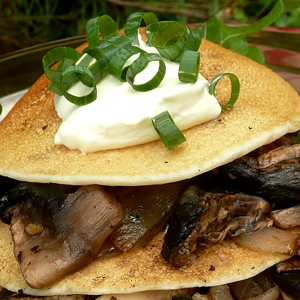
PERFECTLY EASY PANCAKES with MUSHROOMS and ONION
Quick to make, this scrumptious but uncomplicated breakfast is just right for mornings when you want to laze about with an extra cup of tea and watch the visiting birdlife.
Note: Make pancake batter first, then prepare filling while batter rests, then cook pancakes and assemble.
You will need: Bowl and whisk or fork; cutting board and knife; small frypan or skillet and egg lift.
Time: 5 minutes to prepare; 5 minutes to cook filling; 2 minutes for each pancake.
Serves: 2
Pancake batter
1. In a bowl, place ½ cup milk, ½ cup water, 20 ml olive or other vegetable oil, ¼ teaspoon salt, ± 1 egg.
2. Add enough self-raising flour to make a thin batter (¾ cup should do). Beat with a fork or whisk. A few lumps won’t matter. Then rest the batter while onions and mushrooms cook.
Mushroom filling
Ingredients:
1 medium onion, finely sliced
good double-handful roughly chopped uncooked mushrooms (field, flat, button or Swiss brown mushrooms are all fine for this recipe)
fresh black pepper
juice of ½ lemon
clove garlic, crushed
1. Lightly fry sliced onion in splash of olive oil until just starting to colour.
2. Add crushed garlic, lemon juice and pepper then place chopped mushrooms on top of onion and put the lid on the pan.
3. Steam/cook on moderate heat undisturbed for 2 -3 minutes, or until heated through.
4. Tip mushrooms from pan into a bowl and cover to keep warm.
5. In the same frypan, still on moderate heat, slowly pour scant 1/3 cup batter onto the centre spot of the pan and let spread out in an even circle. (No need for any more oil.) Bubbles will form firstly around the edge, then in the centre. Wait until some central bubbles have broken - about 40 seconds - before you flip the pancake. The underside should be an even golden brown.
6. Repeat until batter is used - you should get six saucer-sized pancakes - assembling pancake stacks as you go. (Shown, below, with chopped shallot, low-fat yoghurt and peppery rocket leaves).
FROGBLOG TIPS:
- Don’t peel mushrooms - that is a waste of good flavour. Wipe the caps lightly with a damp cloth if you feel you have to.
- Pancake batter should rest 10 minutes or so before being cooked, allowing flour to swell and the mix to thicken slightly.
- All batter rises better with a touch of salt in the recipe.
- Egg is not an essential ingredient, making an easy menu option for camping or hiking. (The pancakes photographed were made without eggs).
- For dairy-free, substitute water for milk and add an egg for flavour and texture.
- For a gluten-free option, serve the mushrooms with soft or fried polenta, or on top of a good thick slice of gluten-free toast.
A LITTLE MORE ABOUT BIRDS. The other morning, not too early, I was drinking tea in the garden when this handsome fellow flew down beside me. At some stage in his nomadic circuit, he has become used to people. When I went in for my camera, he hopped over to investigate the cup and saucer I left behind.
![]() |
| Mr Handsome - (male) King parrot |
Next: Bubble and squeak for breakfast
Labels:
birds,
breakfast,
brunch,
budget meals,
garden,
Recipes,
vegetarian,
wildlife
Sunday, 2 June 2013
A walk around the garden... to look at mint
Not spearmint, or chocolate mint, or anything else with a fancy name - just old-fashioned garden mint.
Unlike rosemary, mint loves to get its feet into a bit of water now and then. Like rosemary, though, it is tough once established and will go on and on - and all through the garden, if not contained. So, for this gardener’s peace of mind and the mint’s good health, I keep it a pot. Big pot, sitting in a deep bowl that can be partly filled with water if the gardener is going away for a few days. Recently I forgot to do that, and the mint looked rather sad when I came home (ie dead). But I gave it a haircut and a dose of ¼-strength seaweed emulsion, and within a week it was shooting away again.
Mint and rosemary, both strong and aromatic, can be used interchangeably in recipes for sweets and meats, but with quite a different end effect on flavour. Think roast lamb; yoghurt marinated lamb chops; fruit salad; garden salad - each with a touch of mint or hint of rosemary. Both work. I love mint because the smell reminds me of my grandmother. One of my earliest memories is of watching her make mint sauce, rocking the knife back and forth across the mint which she had covered with sugar so the leaves would bruise and crush, releasing maximum flavour.
MINT SAUCE
Strip leaves from several sprigs of garden mint and place on a chopping board. Add 1- 2 teaspoons sugar, and chop the mint through the sugar until finely shredded and bruised. Put this sticky, minty mix into a small jug with ¼ teaspoon salt, and cover with 20 ml boiling water. Stir until sugar has dissolved and top up with ¼ -½ cup brown or malt vinegar. Taste. Add more salt if needed. Will keep indefinitely in fridge, but mint sauce takes only a minute to do and tastes best when freshly made.
MINT and YOGHURT MARINADE
This is a quick-and-easy idea for adding zest to a pair of BBQ stalwarts - the good ol’ Aussie lamb chop and fillet of chicken breast, both of which can easily become a tad dry when done on the barbecue. Plan ahead and marinate overnight if possible, or for a few hours on the morning of feasting. When barbecued (grilled or pan-fried), the marinade forms a crispy crust. Also excellent for oven-baking, and makes enough for 6 portions.
To 1 cup plain yoghurt add 2 teaspoons grated lemon peel, 1 or 2 cloves crushed garlic, 1 teaspoon fresh black pepper, 2 teaspoons plain flour and as much roughly chopped garden mint as you wish. Mix well. Spread generously over both sides of lamb or chicken. Place in single layer and refrigerate until 30 minutes before cooking.
MINT and YOGHURT DIP
Very easy. As above, without the flour (and minus the meat, of course). Great to take on a picnic with a crusty loaf.
Next: We'll be down on the farm for breakfast with birds
Written and compiled by two frogs.
Monday, 27 May 2013
Chicken. Chook chook chooky...
LET’S TALK ABOUT LOW-BUDGET CHICKEN PIECES or …
… HOW TO MAKE A COMPLETE MEAL FOR 4 PEOPLE @ $1.25 per SERVE.
KEEP IN MIND, however, that the $5 total does not include gas for the stove, electricity to run fridge and freezer, the cook’s hourly rate (should he/she have one), the fuel to and from the supermarket, the cost of hot water and detergent and rubber gloves, or dishwasher-running cost (should he/she have one), and so on and so on. In other words, don’t take at face value everything you read or hear about food - not even on a Frog Blog. There is a Big Bad Business World full of bold and subtle advertising that drives our eating habits and food beliefs. However, I do think it is possible, on a low budget, to eat very well and with great joy. (When an activity is compulsory several times a day for the whole of life, an expectation of being joyful on the job surely helps!)
It also helps if one likes to eat chicken. For quick, cheap, tasty meals (no, I don’t eat my own feathery friends), I keep a few 1 kg bags of frozen mixed chicken pieces in the small chest freezer (which is really very economical to run, especially when the food stuff comes home already frozen). Supermarket chicken. Neither free-range nor organic, although the producer assures me on the packaging that the chickens are all barn-raised, grain-fed, free from hormones etc. Mind you, Australian Food Standards require that all chicken for human consumption be free from hormones and antibiotics. At about $4/kilo, the chicken pieces are literally a mixed bag, but at that price... Today’s bag, for example contained 2 wings, 1 drumstick, 3 thigh pieces and a large piece of breast on the bone (which is the juiciest way to cook breast, so that’s fine); whereas the chicken photographed at the end of this post, in tomato-based sauce, came in a bag of eight small tidy thigh pieces. Just right for 4 serves.
I
always skin chicken. 1 kg, whether in the shape of a whole free-range
bird or budget pieces, will yield 150-200 grams skin and fat. That’s an
awful lot of saturated fat; it is also, unfortunately, where much of the
flavour lies. So, I extract that flavour by using the skin and fat to
make stock. Always. The job takes ten minutes, using the pan the chicken
will be cooked in (saves washing up). The stock can be made while
marinating other flavours into the poor denuded chicken. It is easy to
do, as the Town Frog pointed out a little while ago. We’re including another version to hammer home the point - Don't waste, don't toss.
CHICKEN STOCK from fat scraps.
In
a saucepan, fry until golden, 1 diced onion, a few grinds of black
pepper, chicken skin and fat. Add herbs if handy - bay and old rosemary
stems. When coloured, add 1 cup water. Simmer 10 minutes. With a slotted
spoon, remove skin (to the dog-food tin, which is safe for Fido as no
fat remains). Pour stock into small heat-proof bowl, a layer of liquid
fat will rise to the surface. Cool, then refrigerate. When the fat is
white and firm, peel it from the now jellied stock. Fat will clump and
lift off in one piece leaving a fat-free stock.
I usually feed the fat to the backyard egg-layers, mixed in with other kitchen scraps. The girls fight for it - like children scrabbling for chocolate.
The following recipes, using budget chicken pieces, are for easy-to-make, one-pot family meals that provided the whole package-deal of nutrition - carbs, protein, vitamins, minerals, fibre and FLAVOUR. What more could you ask for $1.25 per serve?
CHICKEN PIECES with PEA PILAU RICE (photo, above)
Cooked all in one pan, the lightly marinated chicken provides the cooking liquor and flavour for the rice on which it is served.
Serves 4
10 minutes to prepare. 30 minutes to marinate. 40 minutes cooking time.
You will need: Deep stovetop frypan with a lid; meat-cutting board, onion-cutting board, sharp knife; large dinner plate slightly larger than frypan diameter; 1 cup measure; citrus juicer; serving platter or serve from the pan.
Ingredients:
1 kg mixed chicken pieces, bone in (for big eaters, use extra chicken)
1 large onion, diced
1 lime or ½ lemon, juiced
1 rounded teaspoon mild curry paste (or dry spice powder and ¼ teaspoon salt)
1¼ cups long grain white rice, or Thai jasmine or Basmati rice
2 cups water
1 cup fresh/frozen peas, or ½ cup dehydrated peas soaked in 1 cup water
vegetable cooking oil (preferably not olive - wrong flavour)
Quick instructions: Skin chicken; marinate 30 min in lime and curry mix. Fry diced onion then lie the chicken on top; pour in marinade; simmer/steam with lid on 30 min or until cooked. Remove chicken. Add rice to pan and enough water to make pan juices up to about 3 cups; steam rice under lid 10 minutes. Add peas and return chicken. Cover tightly; continue to steam 5 minutes more until rice is soft.
Step-by-step instructions:
1. With your fingers, pull the skin from the chicken pieces. Trim fat (keep to make stock).
2. Place chicken pieces on a large flat plate.
3. Mix lime juice and curry, and add enough water to make ½ cup of mix; spoon over chicken. Marinate 30 minutes.
4. If using de-hydrated peas, soak in 1 cup water while chicken marinates.
5. Lightly fry onion in a little oil. Add chicken, bone-side down, marinade juices and extra ½ cup water.
6. Put the lid on the pan; simmer/steam on low heat 30 minutes. If the lid is not tight-fitting, may need to increase cooking time to 40 minutes, and check to be sure there is still liquid in the pan. Add more water to keep about ½ cm of pan juice.
7. Remove the chicken to a clean plate. Tip the pan juices into a measuring jug, and add water to make up to three cups (roughly 700ml).
8. Tip rice into the pan; stir to coat in residual chicken grease (there will be a small amount); then add liquid all at once. Stir until simmering. If using dehydrated peas, add soaked peas to rice. Turn heat to low; put the lid on and cook 10 minutes.
9. Stir the rice very lightly with a fork. The grains will still be firm-ish and should look wet. If looking dry add ¼ cup more water. Taste and add salt if needed.
10. If using fresh peas, place them over rice, then arrange the chicken pieces neatly on top, bone-side down. Cover and continue to cook further 5 minutes until rice is soft and peas are heated through.
To serve, take the pan to the table as is; or arrange chicken over rice on a platter. The dish is fine as a meal on its own, or dressed up for a party with a selection of small salads, Indian-style.
SPICY CHICKEN PIECES and SAVOURY RICE
Serves 4. Use will need: Deep stovetop frypan with a lid; meat-cutting board, onion-cutting board, sharp knife; large dinner plate slightly larger than frypan diameter; 1 cup measure.
Ingredients:
1kg chicken pieces
1 large onion, diced
2 large carrots, finely cubed
2 sticks celery and/or other seasonal green vegetables, chopped finely
1 tablespoon mild curry paste
1¼ cups long grain rice
water
Optional: ½ cup lemon juice
1. Skin chicken (see above!). Add ½ cup water (or lemon juice) to paste and coat chicken. Let stand 30 minutes.
2. While chicken marinates, dice onion and vegetables. Lightly fry all in pan with little oil. When just coloured, tip into a bowl.
3. Add chicken and marinade juices to pan; tip vegetables over the chicken, and extra ½ cup water. Cover to steam/simmer 30 minutes.
4. Lift cooked chicken to a plate. Add rice and water to vegetables in pan; stir until simmering then cover and steam 10 minutes.
5. Stir rice. Taste. Add sprinkle salt if needed. Add chicken pieces on top. Steam a further 5 minutes.
ONE-POT CHICKEN with POTATO and OLIVES
Complete meal for 6 hearty eaters, using 2 bags of budget chicken pieces.
Ingredients:
2 kg mixed chicken or thigh pieces, bone in
2 medium onions, diced
4 - 6 tomatoes, diced (about 2 cups pulp, or 400gm can good-quality crushed tomato)
1 large carrot, cut into 1 cm cubes
2 stalks celery, chopped
fresh rosemary, parsley &/or basil, salt and pepper
olive oil
1 - 2 small scrubbed potatoes per person, cut into quarters or 6 pieces
½ cup crushed green or small black olives
1. Over medium heat, in deep frypan or wide saucepan, lightly fry onion, celery and carrot in small amount olive oil until onion starts to colour.
2. As vegetables cook, skin chicken pieces.
3. Add tomato to pan with few sprigs fresh rosemary, freshly ground black pepper and salt to taste (start with ½ teaspoon if using fresh tomato; less with canned tomato). Bring to boil, stirring now and then.
4. Place chicken pieces in sauce, bone sides down. Simmer gently for 15 minutes with lid on. (Don’t worry if chicken is not fully covered by sauce.)
5. Turn the chicken. Place chopped potato in a layer over the top pushing the potato down against the chicken with a spatula. Replace lid. Simmer further 15 minutes or until potato is tender to a fork.
6. Add olives over potato. Turn off the heat and leave the pot to sit, lid on, for a further 10 minutes before serving from the pan. Garnish with a sprinkle of chopped herbs.
Alternatively, omit potato (as shown above), and serve with steamed rice or crusty bread.
Next: Garden mint, and making old-fashioned mint sauce.
Written and compiled by two frogs
… HOW TO MAKE A COMPLETE MEAL FOR 4 PEOPLE @ $1.25 per SERVE.
KEEP IN MIND, however, that the $5 total does not include gas for the stove, electricity to run fridge and freezer, the cook’s hourly rate (should he/she have one), the fuel to and from the supermarket, the cost of hot water and detergent and rubber gloves, or dishwasher-running cost (should he/she have one), and so on and so on. In other words, don’t take at face value everything you read or hear about food - not even on a Frog Blog. There is a Big Bad Business World full of bold and subtle advertising that drives our eating habits and food beliefs. However, I do think it is possible, on a low budget, to eat very well and with great joy. (When an activity is compulsory several times a day for the whole of life, an expectation of being joyful on the job surely helps!)
It also helps if one likes to eat chicken. For quick, cheap, tasty meals (no, I don’t eat my own feathery friends), I keep a few 1 kg bags of frozen mixed chicken pieces in the small chest freezer (which is really very economical to run, especially when the food stuff comes home already frozen). Supermarket chicken. Neither free-range nor organic, although the producer assures me on the packaging that the chickens are all barn-raised, grain-fed, free from hormones etc. Mind you, Australian Food Standards require that all chicken for human consumption be free from hormones and antibiotics. At about $4/kilo, the chicken pieces are literally a mixed bag, but at that price... Today’s bag, for example contained 2 wings, 1 drumstick, 3 thigh pieces and a large piece of breast on the bone (which is the juiciest way to cook breast, so that’s fine); whereas the chicken photographed at the end of this post, in tomato-based sauce, came in a bag of eight small tidy thigh pieces. Just right for 4 serves.
![]() |
| Chicken from a mixed bag - with pea pilau |
CHICKEN STOCK from fat scraps.
![]() |
| Removing set fat from stock |
I usually feed the fat to the backyard egg-layers, mixed in with other kitchen scraps. The girls fight for it - like children scrabbling for chocolate.
The following recipes, using budget chicken pieces, are for easy-to-make, one-pot family meals that provided the whole package-deal of nutrition - carbs, protein, vitamins, minerals, fibre and FLAVOUR. What more could you ask for $1.25 per serve?
CHICKEN PIECES with PEA PILAU RICE (photo, above)
Cooked all in one pan, the lightly marinated chicken provides the cooking liquor and flavour for the rice on which it is served.
Serves 4
10 minutes to prepare. 30 minutes to marinate. 40 minutes cooking time.
You will need: Deep stovetop frypan with a lid; meat-cutting board, onion-cutting board, sharp knife; large dinner plate slightly larger than frypan diameter; 1 cup measure; citrus juicer; serving platter or serve from the pan.
Ingredients:
1 kg mixed chicken pieces, bone in (for big eaters, use extra chicken)
1 large onion, diced
1 lime or ½ lemon, juiced
1 rounded teaspoon mild curry paste (or dry spice powder and ¼ teaspoon salt)
1¼ cups long grain white rice, or Thai jasmine or Basmati rice
2 cups water
1 cup fresh/frozen peas, or ½ cup dehydrated peas soaked in 1 cup water
vegetable cooking oil (preferably not olive - wrong flavour)
Quick instructions: Skin chicken; marinate 30 min in lime and curry mix. Fry diced onion then lie the chicken on top; pour in marinade; simmer/steam with lid on 30 min or until cooked. Remove chicken. Add rice to pan and enough water to make pan juices up to about 3 cups; steam rice under lid 10 minutes. Add peas and return chicken. Cover tightly; continue to steam 5 minutes more until rice is soft.
Step-by-step instructions:
1. With your fingers, pull the skin from the chicken pieces. Trim fat (keep to make stock).
2. Place chicken pieces on a large flat plate.
3. Mix lime juice and curry, and add enough water to make ½ cup of mix; spoon over chicken. Marinate 30 minutes.
4. If using de-hydrated peas, soak in 1 cup water while chicken marinates.
5. Lightly fry onion in a little oil. Add chicken, bone-side down, marinade juices and extra ½ cup water.
6. Put the lid on the pan; simmer/steam on low heat 30 minutes. If the lid is not tight-fitting, may need to increase cooking time to 40 minutes, and check to be sure there is still liquid in the pan. Add more water to keep about ½ cm of pan juice.
7. Remove the chicken to a clean plate. Tip the pan juices into a measuring jug, and add water to make up to three cups (roughly 700ml).
8. Tip rice into the pan; stir to coat in residual chicken grease (there will be a small amount); then add liquid all at once. Stir until simmering. If using dehydrated peas, add soaked peas to rice. Turn heat to low; put the lid on and cook 10 minutes.
9. Stir the rice very lightly with a fork. The grains will still be firm-ish and should look wet. If looking dry add ¼ cup more water. Taste and add salt if needed.
10. If using fresh peas, place them over rice, then arrange the chicken pieces neatly on top, bone-side down. Cover and continue to cook further 5 minutes until rice is soft and peas are heated through.
To serve, take the pan to the table as is; or arrange chicken over rice on a platter. The dish is fine as a meal on its own, or dressed up for a party with a selection of small salads, Indian-style.
SPICY CHICKEN PIECES and SAVOURY RICE
Serves 4. Use will need: Deep stovetop frypan with a lid; meat-cutting board, onion-cutting board, sharp knife; large dinner plate slightly larger than frypan diameter; 1 cup measure.
Ingredients:
1kg chicken pieces
1 large onion, diced
2 large carrots, finely cubed
2 sticks celery and/or other seasonal green vegetables, chopped finely
1 tablespoon mild curry paste
1¼ cups long grain rice
water
Optional: ½ cup lemon juice
1. Skin chicken (see above!). Add ½ cup water (or lemon juice) to paste and coat chicken. Let stand 30 minutes.
2. While chicken marinates, dice onion and vegetables. Lightly fry all in pan with little oil. When just coloured, tip into a bowl.
3. Add chicken and marinade juices to pan; tip vegetables over the chicken, and extra ½ cup water. Cover to steam/simmer 30 minutes.
4. Lift cooked chicken to a plate. Add rice and water to vegetables in pan; stir until simmering then cover and steam 10 minutes.
5. Stir rice. Taste. Add sprinkle salt if needed. Add chicken pieces on top. Steam a further 5 minutes.
ONE-POT CHICKEN with POTATO and OLIVES
Complete meal for 6 hearty eaters, using 2 bags of budget chicken pieces.
Ingredients:
2 kg mixed chicken or thigh pieces, bone in
2 medium onions, diced
4 - 6 tomatoes, diced (about 2 cups pulp, or 400gm can good-quality crushed tomato)
1 large carrot, cut into 1 cm cubes
2 stalks celery, chopped
fresh rosemary, parsley &/or basil, salt and pepper
olive oil
1 - 2 small scrubbed potatoes per person, cut into quarters or 6 pieces
½ cup crushed green or small black olives
1. Over medium heat, in deep frypan or wide saucepan, lightly fry onion, celery and carrot in small amount olive oil until onion starts to colour.
2. As vegetables cook, skin chicken pieces.
3. Add tomato to pan with few sprigs fresh rosemary, freshly ground black pepper and salt to taste (start with ½ teaspoon if using fresh tomato; less with canned tomato). Bring to boil, stirring now and then.
4. Place chicken pieces in sauce, bone sides down. Simmer gently for 15 minutes with lid on. (Don’t worry if chicken is not fully covered by sauce.)
5. Turn the chicken. Place chopped potato in a layer over the top pushing the potato down against the chicken with a spatula. Replace lid. Simmer further 15 minutes or until potato is tender to a fork.
6. Add olives over potato. Turn off the heat and leave the pot to sit, lid on, for a further 10 minutes before serving from the pan. Garnish with a sprinkle of chopped herbs.
Alternatively, omit potato (as shown above), and serve with steamed rice or crusty bread.
Next: Garden mint, and making old-fashioned mint sauce.
Written and compiled by two frogs
Labels:
budget meals,
chicken,
curry,
olives,
one pot meals,
philosophy,
Recipes,
rice
Thursday, 21 March 2013
Town Frog's light lunch for business friends
I have asked some clients to lunch. I’m still gaining confidence with homemade curry paste, so I will use my usual dry spices with added fresh garlic and ginger. Local mangoes are in the fruit shops, so they will be lovely for garnish, along with a lime grown by the Country Frog.
Because it is the middle of a working day, and the weather is warm, I want the meal to be fresh and light. We will have only an hour to eat and talk, so I prefer not to be cooking when the guests are here. This calls for a Town Frog Action Plan (in any other language, a list).
1. Menu
Pork with silverbeet and red peppers
Fresh green beans with ginger
Spicy eggplant
Dhal (not too sloppy)
On the side: pappadums, relish, mango, lime, chillies
2. Stuff I will need
Pork: meat chopping board, large pan with lid (serve from the pan)
Beans: onion board, small pan with lid, flat serving plate
Eggplant: same board, medium pan with lid, serving bowl (white?)
Dhal: small saucepan, groovy serving bowl
Pappadums, pickles, mango, limes: small dishes
3. Action plan
Before work:
Cut vegetables (except eggplant which discolours)
Cut onions, crush garlic, slice ginger (put in water to stop discolouring)
Lay table (colour coordinate!)
Morning break:
Cook up pork but don't add greens
Cook dhal
15 mins before guests due:
Cook up storm!
Don't forget the pappadums...
MILD PORK CURRY with silverbeet and red pepper
Cooking time: 30 minutes
Ingredients:
½ kilo pork, cubed (or minced)
2 onions, diced
5 - 6 large leaves silverbeet, shredded (or 150 - 250 gm frozen, thawed and drained)
1 large red pepper/capsicum, diced (1 cup)
4 - 6 cm fresh ginger root, grated
½ cup fresh lime juice
Cooking oil
1- 1½ cups water
2 tablespoons mild (yellow) curry paste/ for hotter curry 1 tablespoon red curry paste
1. In a bowl, place pork, onion, ginger and curry paste; mix well to coat the pork.
2. Fry red pepper in a little oil. Set aside in bowl.
3. In same pan, fry pork and spice for about 5 minutes.
4. Add water and lime juice. Cover and simmer 30 minutes until pork is tender.
5. If preparing ahead, turn off heat and leave covered. To finish, stir in peppers and greens, and bring to a good boil for 5 minutes.
DRY RED LENTIL DHAL
Cooking time: 10 minutes
In a small saucepan lightly fry 1 sliced onion, 1 star anise, ½ stick of cinnamon bark, crushed garlic. Add ¼ teaspoon salt, 1 generous cup red lentils and 2¼ cups (280ml) water. Simmer ten minutes until liquid has been absorbed and lentils are soft. Add more water if needed.
SIDE DISHES - fresh sliced mango, lime, chilli, and fruit relish
I will finishing the “prepare ahead” part of the meal by opening a jar of Brown Frog’s mango relish. Not too sweet and there is bite from added chillies. In a future blog, we will share recipes for country-style pickles, chutney, and relish. For now, here is a vegetarian alternative to the pork in the above curry.
Vegetarian LENTIL CURRY with silverbeet and red peppers.
Substitute ¾ cup uncooked brown or green lentils, adding them at Step 4 of the pork recipe. Simmer for 20 minutes, then stir in 1 cup cubed potato and/or pumpkin. Continue to cook with the lid on until lentils and potato are soft, then add fried peppers and shredded silverbeet. Mix up from the bottom with spatula so as not to break the potato.
Next time: Side dishes for my light lunch - fresh beans with ginger, and spicy eggplant.
Written and compiled by two frogs.
Subscribe to:
Posts (Atom)


.jpg)